
The Firewall Has Fallen: How Bost Just Rewrote the Rules of Power
0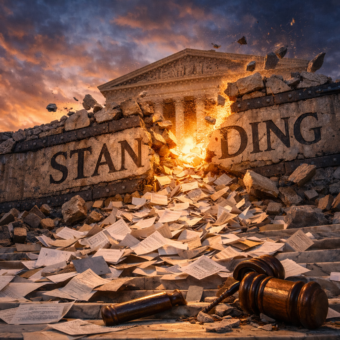
We often look for the end of an era in explosions, riots, insurrections, or shocking election nights. But more often, the architecture of a republic is remodeled in the quiet, carpeted chambers of the judiciary, amidst the rustling of robes and the scratching of pens.
Yesterday, January 14, 2026, the Supreme Court took a sledgehammer to one of the most critical, yet invisible, load-bearing walls of American democracy.
In a 7-2 ruling in Bost v. Illinois State Board of Elections, the Court held that political candidates have automatic “standing” to sue over election rules, regardless of whether they can prove those rules will cost them the election. To the average citizen, this sounds like dry legalese. To anyone who understands the mechanics of the 2020 election, it is a seismic shift that effectively institutionalizes the “forever campaign.”
To understand why this matters, we have to look back at what actually saved the transition of power six years ago. It wasn’t the politicians. It was a procedural doctrine called “standing.” And as of yesterday, that doctrine is dead.
The Unsung Hero of 2020
When we remember the chaotic aftermath of the 2020 election, we remember the noise: the press conferences at landscaping companies, the angry tweets, the march on the Capitol. What we forget is the silence of the courtrooms.
Between November 3, 2020, and January 6, 2021, the Trump campaign and its allies filed over 60 lawsuits. They lost almost all of them. But they didn’t lose because judges examined the evidence of fraud and found it wanting (though that happened occasionally). They lost because they couldn’t get past the bouncer.
That bouncer was Article III Standing.
For decades, federal courts have held to a strict rule: you cannot sue the government just because you are angry about a law. You must prove you were injured by it. In election cases, this meant a candidate had to show that a specific rule, say, a drop box in Wisconsin or a signature cure period in Pennsylvania, specifically cost them votes that would flip the election.
This was the “Standing Firewall.” In case after case, Trump v. Wisconsin, Bognet v. Pennsylvania—judges tossed the lawsuits out at the threshold. They effectively said, “You cannot prove this specific rule caused you to lose, so we will not even hear the case.”
This procedural dismissal was the system’s immune response. It prevented the courts from becoming a tool to delay certification. It kept the clock running, ensuring the “Safe Harbor” deadlines were met, which in turn forced Congress to accept the results.
The Bost Doctrine: A VIP Pass to Litigation
Yesterday, Chief Justice Roberts, writing for the majority, dismantled that firewall.
By ruling that a candidate’s “interest in the integrity of the election process” is sufficient for standing, the Court has removed the requirement to prove specific injury. No longer does a campaign have to prove a rule will cost them the race. They simply have to argue the rule is incorrect.
Justice Barrett, in her concurrence, tried to limit the damage, suggesting standing should be tied to financial costs (the money spent watching polls). But the damage is done. The Majority has effectively ruled that candidates are a special class of citizen with a “concrete and particularized interest” in the rules of the game, separate from the outcome of the game.
The Paradox of the Watchdogs
In a twist of bitter irony, the dismantling of this firewall was aided by the very groups most terrified of the result. During the Bost proceedings, civil rights organizations—typically the guardians of voting access—filed briefs supporting Bost’s right to sue. Why? Because they feared that if the Court narrowed “standing” too much to stop Bost, it would also block them from suing to protect voters in future civil rights cases.
They made a calculated gamble: support the politician’s right to enter the courthouse in order to preserve their own. It backfired. They hoped the Court would grant standing but rule against Bost on the facts. Instead, the Court took their advice on standing and used it to kick the door off its hinges, granting broad license to the very “election integrity” lawsuits these groups were trying to prevent. In trying to keep a key for themselves, they inadvertently unlocked the gate for the opposition.
The Weaponization of “Discovery”
Why does this technicality matter? Because in the legal world, “standing” is the difference between a lawsuit that takes three days and a lawsuit that takes three months.
In 2020, because the plaintiffs lacked standing, they were denied “discovery”, the power to subpoena documents, depose witnesses, and access internal government files.
Under the Bost rules, a losing candidate in November 2026 will not have their case dismissed. They will be granted standing. They will then proceed to discovery. They will be able to force county election boards to turn over server logs, signature databases, and email chains while the count is still happening.
Imagine a close election in Pennsylvania where the result hangs on 10,000 votes. Under the old rules, a lawsuit challenging the signature matching process would be tossed for lack of proof. Under Bost, a federal judge can order a “preservation of evidence” and a “discovery period” to review those signatures.
The counting stops. The certification deadline passes. The “Safe Harbor” protection evaporates.
The Era of “Regulation by Litigation”
We are moving from a system where elections are settled by counting votes to a system where elections are settled by litigating rules.
This decision incentivizes what can only be called “offensive lawfare.” Well-funded campaigns will no longer wait for Election Day to see if there are irregularities. They will sue months in advance to strike down any rule, early voting windows, mail-in deadlines, cure periods, that they view as disadvantageous, confident that the federal courts are now open for business.
We have effectively federalized the minutiae of state elections. Instead of state legislatures deciding how many days you have to mail a ballot, a federal judge will decide if that timeline violates a candidate’s “interest in election integrity.”
The Fragility of the Finish Line
The Bost decision does not guarantee that elections will be stolen. But it guarantees they will be contested.
By removing the procedural barrier that kept the 2020 chaos in check, the Supreme Court has signaled that the “settling” of an election is no longer an administrative task, but a legal one. The transition of power will no longer be determined by who has the most votes on election night, but by whose legal team can navigate the labyrinth of federal discovery before the clock runs out on the Electoral College.
In 2020, the system held because the doors to the courthouse were locked. Yesterday, the Supreme Court just gave every candidate a key.